Under Armour

Thursday, May 5, 2011

Cutest Baby on Earth

Saturday, January 30, 2010

Snowy Paris

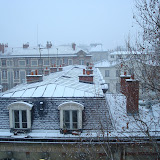
Paris in the snow. Doesn't usually happen. But when it does, it's beautiful. It gives a new perspective to old monuments, ones you don't usually see under a blanket of white. Please enjoy these photos with some hot cocoa.


Snowy Paris

Monday, October 5, 2009

A Weekend in Normandy

Two weekends ago, we traveled by train and bus to the Upper Normandy coast, known for its falaises (cliffs). We started out in Fécamp, a resort town in an inlet with a small harbor and rocky beach. On the western side of town, we hiked up a campground and began our backpacking along the steep white cliffs. Here we were a bit inland, walking through cornfields and past grazing cows, with only a distant view of the sea blending into the gray-blue sky, only the occasional tiny white triangles of sailboats marking the extent of the horizon. It was a sunny early autumn day, and small red-orange poppies dotted the grass between the gravel road and the browning cornstalks. Happy cows on small farms watched us pass close by, just on the other side of the barbwire fence.

After about three miles we descended into Yport, a smaller town constrained by a smaller inlet than that of Fécamp. The houses were built in a pattern of red brick and gray stone, and the small yards were filled with the fading colors of recently deep pink hydrangea. We discovered that the town's boulanger (baker) was away on his annual vacation, so the neighboring boucherie (butcher shop) had become the temporary "depot de pain." That afternoon we stocked up camping provisions, including a pre-packaged Alsatian choucroute and a bottle of regional cider.

Our campground was in the same position as the one we walked though in the last town, on the western edge of town and most of the way up the steep hillside. With only a few other fellow campers braving the cool nights in late September, the normally communal style of French campgrounds was made a little more private. We pitched our tent in a clearing overlooking the town, the beach and the sea. The campground office was located in an old farmhouse-turned-inn, which apparently also functioned as a cocktail bar for local weddings. (That's right, just a hundred yards away from us in our hiking boots cooking on our camp stove, a wedding party took pictures and drank champagne under a small tent. It certainly wasn't fancy but the view was spectacular.) The evening was cool and a bit misty, but upon waking late that night I was rewarded with something you just can't find in Paris -- a star-filled sky and the soft sound of the sea below us.

The next morning we descended to town to pick up a baguette from the butcher shop, and back at camp, while Rob made breakfast, I observed the dozen or so perfect webs the spiders had spun in the adjacent field that night. The day was just as promising as the day before -- bright blue sky and just a hint of an autumn breeze.

Today was a longer hike, about six miles from Yport to Etretat. It started with such similarity to Saturday's hike that I have a hard time distinguishing the two, but then the trail left the farm roads and turned north to the cliffs. We followed the white cliffs westward, just a few steps and a line of blackberry bushes from the edge. Church steeples in tiny villages peeked over the trees on the other side of the cow pastures, which extended right up to the trail on the edge of the cliff. At one point we descended steeply into a ravine which opened out onto a rocky, seaweed-strewn beach, but otherwise the cliffs in this part of the coast were uniformly quite high. A friendly mountain biker warned us (in a Normandy accent I found very difficult to understand) of dangerously eroded trail west of Etretat, making me wonder what the coastline looked like a hundred years ago, and how it will appear a hundred years from now.

We knew we were nearing our destination as we began passing more and more nicely-dressed people out for a Sunday walk. The draw around Etretat is a couple of curious rock formations protruding out into the sea, including l'Aiguille (the Needle) and the arch of the Falaise d'Aval.

At the end of our trail, we descended the crowded steps onto Etretat's steep and pebbly beach, where the clear, cool water looked very inviting. The ebbing of small waves through the smooth, gray stones made a gentle clacking sound, pleasant to hear but painful to walk on barefoot! We spent the afternoon swimming (Rob), napping (me) and enjoying a take-out kebab lunch before catching the bus to Le Havre, then the train back to Paris.

Au revoir, l'été!

Wednesday, July 22, 2009

Iceland, Part Three

The next day we drove north to Húsavík, a fishing village and popular whale-watching destination on the eastern shore of the bay of Skálfandi. In town, we opted to visit the whale museum instead of the phallological museum (world's largest collect of penises, over 200 species!), which was an incredibly informative tour, housed in an old slaughterhose and containing the complete skeletons of eight or so different species of whales suspended from the rafters.

Continuing north on the Tjörnes peninsula, low-lying clouds sometimes thinned enough for us to glimpse the mountains on the opposite shore, a dark ridge draped with snowdrifts rising steeply out of the Arctic. On our side of the bay, however, was low farmland on bluffs overlooking the sea. Ahead of us, we spotted a waterfall cascading onto the beach, and so begins our first adventure of the day.

We parked by the side of the road at the presumed creek, hopped a low fence, and attempted to hike down to the afore-mentioned waterfall. We didn't make it, due to the incorrect assumption that we were crossing just another sheep pasture. Instead, a curious black stallion was alerted by two mares in the neighboring enclosure, suddenly appeared at the top of the hill and unhesitatingly galloped down to us. Now, Iceland horse are quite small, but not being associated with their habits (or any other horse's habits, for that matter), we quickly retreated, hoping he wouldn't react to the certain smell of fear surrounding us and vowing to learn a little bit about common farm animals.

Back in the Land Rover, we headed to the crumbling brown cliffs on the peninsula's northern tip in search of a much different animal -- puffins! We spotted their unmistakeable orange beaks and black and white bodies from above, as they clumsily flew, low over the water, to their nests in the cliff walls. Not having binonculars and desiring a closer view, we drove a few miles east where the road descends to the beach for adventure #2 of the day: Puffin Quest. For nearly an hour we picked our way over rocks like dinosaur eggs piled at the base of the cliffs. But alas, it was too far, and we were late for dinner at Ingibjorg's house back in Akureyri. At least I got to touch the Arctic Ocean for the first time -- cold, clear and a deep blue-gray, gently lapping at the shores of the black sand beaches.

We had a couple more days, more delicious and relaxing family meals in Akureyri and on our way back in Reykjavik, but I will leave off with this last bit. That night, we drove the seasonal road over the top of the mountain between Akureyri and the summer house. It was 12:30, and in the north the sun was setting, skimming slowly over the sea between mountains in the narrow entrance to the fjord. No sound carried up from the city west across the water; there was hardly a breeze, but the air was cool and pure. No other cars were on the old gravel road, only an old ewe and two lambs grazing nearby. The mountains and the sky had faded to dusty pink, lavender, blue and gray. I've never believed the artists who painted landscapes in such colors, but, I guess so far north on such a drawn-out sunset, things become softer -- a film covering the world to blur the distinction between sky, mountain, city, sea.

Friday, July 17, 2009

Iceland, Part Two

Flying into Akureyri was definitely the coolest flight I've experienced. After flying over inland mountains and glaciers for half an hour, we gradually descended into Eyjafjörður, the longest fjord in Iceland. For 15 minutes we flew between the barren, snow-covered highland plateaus, as the grassy green valley floor, dotted with red-roofed farm buildings, opened up beneath us. At eye level, sheep grazed on the steep mountainsides and countless early summer streams cascaded into the valley. Flying north, farms gave way to Akureyri and the waters of the fjord, and we circled around to land.

Akureyri is Iceland's second largest city, population 17,000, and home to most of Rob's Icelandic relatives. We were immediately welcomed by uncle Addu and girlfriend Ästa, both sunburned from a recent mountain climbing trip, and convivial (though mourning her English skills) great-aunt Helga-Maggy. As I donned my new windbreaker and considered putting my boots on, the others, outside in short-sleeves and eating ice cream, commented on the warmth of the weather. (Side note, I think I ate more ice cream in Iceland than I have in the past three months.)

That evening, everyone (Ingibjorg, Guðmunder and four kids included) drove over the mountain range to have a barbeque at the summer house, built by Rob’s grandparents, in the next valley. It’s a comfortable, modern pine cabin secluded from the road by young trees, the fringe of the country’s second largest forest -- which is not very big, since from settlement in the 9th century until recently, trees have been practically unheard in Iceland, although today everyone is planting them. Water is piped in directly from the creek running alongside, which is bordered in summer by indigo and white Artic lupine, and runs into a river just downstream. On the opposite bank, a grazing field ascends a steep hill between the creek and the river, and there are popular campsites a mile upriver.

Rob’s four young cousins played around the cabin while the adults prepared dinner - salmon on the grill - and Rob and I (adults, yes?) did a little of each and joined in on the English conversation. Evenings are long and relaxed in an Icelandic summer, and we ate until the food was gone, or nearly so, sitting and talking until we had room for seconds or thirds of both dinner and dessert. (All our hosts reminded me of my grandmother -- never so happy as when you manage a third helping.)

The next day, sunny and warm, Rob and I set out in Addu’s Land Rover to visit the sights eastward. Driving out of the forest, we passed through farmland, around lakes, crossed glacial rivers, into the volcanic landscape of Lake Mývatn. South of the lake is green, with a clear salmon river meandering through bright green grasses dotted with yellow flowers; to the west is marshland, off-limits during nesting season, and when the wind blew in the right direction we could hear the cacophony of bird cries while we hiked up the 1500 foot barren conical peak of Vindbelgjarfjall. North of the lake are a small town and 18th century lava fields, as well as the volcanic craters and fissures, where the last minor eruption was only 25 years ago. The lake, however, contains evidence of pre-settlement eruptions in the mound-to-hill-size pseudo craters and tall rock columns, bizarre shapes created when lava flowed into and then out of the lake over a thousand years ago.

At Leirhnjúkur, next to Krafla volcano, where there is another geothermal plant, we walked along the dangerous steaming vents and sulphurous, bubbling mud pots. It’s great, scary fun, although they are building a raised boardwalk over the trail in an attempt to prevent wayward tourists from burning their feet on thin ground. I suppose the sheep will still walk where they choose!

Further east, we drove 20 miles on a gravel road through windy, dusty, gray lands to Dettifoss, the highest waterfall in Europe. This is one of the driest parts of Iceland, and if there was a river on the moon, I think it would look like this. The canyon was impressive, great blocks of rock stacked upon end or tumbled down into the river, and the power of the 45 meter waterfall, which we approached at the top (there are no railings) was amazing.

The aunts had told us that only the week before the temperatures had dipped below freezing in northern Iceland. So on the way back to the summer house I marveled at the variations in the terrain, imagined the harshness of winter in this volcanic and glacier-formed landscape, northern winds bitterly sweeping across the land, and fully appreciated just how nice it was to get a sunburn on a summer day with a southern breeze.

Wednesday, July 15, 2009

Paris shows off its lights

Last night we braved the hordes of Parisians and tourists alike to witness the Fête National (Bastille Day) concert and fireworks display on the packed Champ de Mars. The main lawn approaching the Eiffel Tower was much too crowded for us late-comers, so with some friends we spread our picnic blanket behind some trees on the right corridor of the park. Although we couldn't see the stage, and only parts of the Tower through the tree, the Johnny Halliday (France's Mick Jagger) concert music was blasted throughout and enjoyed by all. Over the next few hours we comfortably enjoyed our wine and thrown-together picnic spread until the sun began to set and the Tower, with lights turned off, was a dark shadow in the twilit sky.

At the sound and tree-obscured sight of the first fireworks, we quickly packed up our picnic remains and moved up to join the standing crowds with a better view, and although some tree limbs blocked the very top of the tower, I was no less amazed at the spectacle.

A light show was projected onto the Tower, depicting in turn the blue, white and red celebrating its creation 120 years ago, a pulsing radio signal, toy soldiers falling to make a skeletal effect remembering the "dark times," and rainbow-colored Flower Power blooms rotating like dancing clockwork. Edith Piaf on the speakers, white, graceful fireworks and the Eiffel Tower's glittering lights (which sparkle hourly on normal evenings) made such a romantic setting for the pre-war years; red lights above and fire-like blasts surrounding the base of the Tower, combined with an intense orchestral piece, evoked both an awe-inspiring and a truly scary World War II scene in front of us. My favorite part was the countdown before the grand finale, when only the light projections were used to make the Tower dance, and then jump, like a gigantic Eiffel Tower robot pounding away in the darkness. And on zero, you guessed it, fireworks lit up the whole sky! Shot out from the top and all sides in a spectacular two-minute finale.

See it for yourself here http://www.youtube.com/watch?v=lUNFxTaCI2c or the whole thing on www.paris.fr, but as it really doesn't do justice to the show, I recommend coming to Paris for the Eiffel Tower's 125th birthday in five years. Joyeux anniversaire, Tour Eiffel!

Tuesday, July 14, 2009

Iceland, Part One

We arrived in Iceland on a cool and rainy Thursday afternoon, just after the longest day of the year. We took the airport bus inland along the lava fields of the Reykjanes Peninsula, stopping at the Blue Lagoon with the other tourists. I can't imagine the cold shock you would feel in dead winter in the five steps from the locker rooms to the outdoor pool, but man even on an Icelandic summer day it felt good to step down into the steaming lagoon. You can see the steam from miles away in fact, outlines by the dark rock of the volcanic ridge behind it. It looks like a small factory, but is the storage and pumping mechanisms for the near-boiling geothermally-heated water that they cool just enough for us to stand. We soaked in the white, steamy, sulphur-smelling pool for an hour before returning to the bus, feeling warm and jello-like despite the cool and uninhabitable surroundings.

Rob's aunt Gudda and uncle Guðmunder picked us up from the bus station. They welcomed us with cold beer, Domino's Pizza and a cozy basement guest room (an ideal place to sleep on a sunny Icelandic summer night, when it gets dim for a few hours but never gets fully dark), and, along with 13-year-old Þorunn, showed us pictures and videos of the many places we were to visit. Icelanders are clearly proud of the amazing geography their country holds, embracing the digital camera as well as the paintbrush to display some of their most striking scenery.

The next day, with me fully prepared wearing sweater, jacket and boots, we toured Reykjavik on what turned out to be a sunny 70° day. It was beautiful to sit by the downtown lake, sparkling in the bright sun, and filled with ducks, geese and their newly hatched offspring. We walked the three miles from the downtown ports back to Gudda's house, through the main shopping/nightlife streets, quiet neighborhoods (mostly smallish concrete houses with green yards and colorful gardens - pansies, peonies), past geometrically-creative Lutheran churches and the new (and only?) mall in the city. Nothing is showy or spectacular, but sitting by the bay in a green valley surrounded by low mountains topped with nearly-melted snow, the city seemed simply quiet, friendly and liveable.

On Saturday we woke up early to a huge breakfast spread of toast, smoked meats, raw veggies, cheese, coffee and donuts, as well as a complete picnic lunch packed for us by our wonderful hostess, to take the popular Golden Circle bus tour around inland southwest Iceland. Our first stop was, unadvertised, at the new geothermal power and water plant, which provides all of Reykjavik's electricity and most of its hot water. (Geothermally-heated water is used, by the way, both to melt snow on city streets and to heat the floor in Gudda's sunroom by running pipes underneath. So crafty these Icelanders are!)

Next we headed to Gullfoss, an impressive waterfall on a river running from the Langjökull glacier, which we could just see to the north, with the higher mountain peaks shrouded in clouds. Then we backtracked ten minutes to the boiling hot springs and geysers at Geysir National Park. Rob and I enjoyed our picnic on a hill above the hot spots, watching Strokkur explode every ten minutes. We didn't witness the other, larger geyser, which doesn't go off regularly, but being named Geysir it is the geyser after which all other exploding hot springs are named.

As the afternoon temperature neared 80° and I stripped off layers of clothing down to my tank top, we sweated and dozed on the bus traveling back west to Þingvellir. Þingvellir is the site of Iceland's largest lake, the world's oldest parliament, and it lies along the North American-Eurasian continental rift, so you can see the canyon proving that Iceland is slowly growing larger. There are also deep fissures filled with crystal-clear lake water, where silver coins sparkle in the sun at the bottom. Pictures cannot show the crispness of colors in the pure northern air. The water was so clean, with islets of bright green grasses dotting the edges. Walking through the black-rock walls of the canyon, I saw clumps of the yellowest buttercups and dandelions, contrasting perfectly with the purplest of violets.

And at that, we returned on the bus to cloudier and cooler Reykjavik, where the bus driver sceptically dropped us off in the residential district while all the other tourists waited to be taken to their hotels. Lucky us!

That night we enjoyed excellent Icelandic salmon and homemade wine at dinner with Rob's (sort of) uncle Bjossi. Afterwards, we walked through Reykjavik's pretty botanical gardens with Bjossi's daughters Hrönn and Linda. We finished our Reykjavik experience that night, when Hronn and another cousin Lena decided to give us a midnight driving tour of Reykjavik's beaches. So, between midnight and 1am, we listened to nesting birds and watched the sun set behind the clouds on the horizon, as Rob played by the freezing water, I blew dandelion seeds and Hronn bathed her feet in a warm-water bath in a hollowed-out rock by the bay, which is apparently a popular place to be on a night such as that one. And we drove over to Reyjavik's heated beach, which is in fact not heated on a Saturday night in summer, probably to prevent drunken (or in our case, non-drunken but equally ridiculous) late-night outings. They then wanted to take us downtown to the all-night bars, but exhausted and knowing we had an early flight to meet more family in Akureyri the next morning, we (being decidedly lame!) declined. And so ended our visit to southern Iceland.

Now to the north!

Monday, July 13, 2009

Good Beer, Cheap Happy Hour

Prominent among the dive bar drinkeries in Paris’ rue des Cannettes is the brewpub O’Neills. On the outside, it looks like your standard European Irish Pub, but in this case looks are deceiving. Come to the inside, and rather than goofy Celtic-themed knick-knacks and the obligatory “Guinness is good for you” posters you’ll get an uncomplicated series of small dining room around a bar, decorated in little else than their copper brew-tanks (on a good day, the bar area will smell like malt). Sit down at the bar, and choose from five basic beer types brewed on site: Amber and Brown ales, Belgian Abbey Style Ale and Belgian Blonde together with a standard Lager/Pilsner. You may even have the choice of a seasonal brew, but I’ve never had the pleasure. The beer is good, and I especially appreciated the Belgian Blonde on a hot summer day. The Brown Ale leaved a little to be desired, but Amber hit the spot, and it’s hard to mess up a Pilsner brewed on site.

If you’re looking for glamorous Paris, this is not it; there is no outdoor seating, and bar stools on the inside are a little sandwiched together. O’Neill’s seems decidedly grungy, and relatively empty at the beginning of happy hour. On the other hand, an empty bar with bi-lingual bartenders and pints beginning priced at 3 euros is a very good way to do a little work on your French. The pace picks up a little at around 8pm at the beginning of the restaurant’s high volume time and service is a little harder to come by. The crowd at O’Neill’s is certainly post-university age, so if you’re looking for a more happening scene, just move two doors down the rue des Cannettes.

O'Neill's Paris

Follow Us on Facebook and Twitter

Come visit Kelley and Rob in their different social networks, on Facebook at rinelson1981 or Kelley Nelson, or on Twitter at rinelson1981.

Thursday, May 21, 2009

Tourism in the Age of the Digital Camera

Picture this: Our visit to France’s picturesque Loire Valley is a perfect retreat from Paris’ hustle and bustle. The day began in Amboise with a little sun, switching to overcast skies as if Mother Nature wanted us to see the countryside in varying shades of light. We quickly escape the nascent downpour in Tours, jump into the car and head to the Chateau de Chenonceau, a marvel of French Renaissance architecture that doubled as a secret smuggling tunnel for the French Resistance of WWII. We make a bee-line for the entrance to avoid a soaking from the mid-May showers. We make it to dry ground at the entrance only to be stopped in our tracks. The culprit? A throng of amateur photographers, intent on recording every single second of their vacation to digital memory.

Now before you hide your head in shame (because you know I’m talking about you, whoever you are), I too own a digital camera. Every once in a while, I will also break out this camera to take a silly picture of a wall, a staircase, a painting or my wife. We’ve got dozens of gigs of memory on our respective laptops that have been filled with photos that will help us fondly remember our trip to the Topkapi Palace. In short, I’m part of the problem, and am far from being a part of the solution.

Nevertheless, the problem with the digital camera is its nearly limitless capacity to take stupid photos, delete them, and then take them again. In the past, a photo was a relatively expensive commodity...one needed to be sure of the value of the photo in order to justify committing it to film and paying for it to be developed. There was no instant check on the quality of the photo, so one snapshot was normally sufficient (generations of amateur photogs learned the hard way that their finger was covering the lens, or that the flash didn’t go off like it should have). The digital camera, on the other hand, can give you instant feedback about how bad a photographer you are...but no matter how bad it was the first time, digital camera users usually opt for that second shot to try and make up for the first. And the third shot to try and make up for the second. And so on, and so on...

Another favored tactic is the saturation approach. Take as many photos as you can, and hope that some of them turn out. This leads to one of my favorite sights at any tourist destination...the tourist being led by his camera, manically snapping up photos of anything that passes in front of his lens. Ditto this for the amateur videographers...if you wanted to see the Louvre through a digital LCD, why not just watch the Travel Channel and save a few thousand bucks.

And don’t get me started on the group photo. When I chaperoned my high school students on their trip to England, I believe I snapped their group photo on about 15 different digital cameras. Isn’t one or two enough? Are we really so misanthropic to think that the person whose camera contains the group photo won’t share it with the rest of the group?

That’s not to say that the Digital Camera hasn’t democratized tourism in a way. More than 60% of US households now own at least one digital camera, and my guess is that among those who still have the means and leisure time to visit rural France, the proportion is markedly higher. This means that almost anyone now has the ability to prove that they went somewhere, saw something, and possibly enjoyed it. And I have nothing against that. What I do find to be irritating is the way in which mass digital camera ownership disrupts the experience of being a tourist, whether it’s you taking the picture or someone else. The increasing ownership of digital cameras, together with the fact that digital cameras are now sold as integral parts of most cell-phones (the quality of some of these cameras being shockingly good) means that their impact upon the tourist industry will continue to grow, for better or for worse.

All this leads me to conclude that the digital camera is tourism’s worst nightmare for two reasons. The first is that all this photo taking bugs the hell out of me. Stop it! The second is that people take photos on trips to take home and show their friends and family that they were there...they saw the Eiffel Tower, went to the top, and took a photo to prove it. Or, they took 200 photos to prove it. But sooner or later, don’t you risk missing the actual experience of being there? Does the digital photo leave the impression that you were gazing down the Seine from your Pont Neuf perch, when in reality, your digital camera did all the gazing for you? My advice to tourists everywhere? Take some good photos to help you remember being there, but most importantly, don’t forget to be there.

Friday, April 24, 2009

Thursday, April 23, 2009

Musings on a Breton Vacation

Finistère is the "end of the earth," the department we explored for six days with Rob's parents last week. Most of a day's drive from Paris, nearly an hour from the closest city (Brest), we experienced the windblown, wild coast where the Celtic Bretons once lived. Crumbling lichen-covered walls and a crude earthen dam showed us a little piece of the past, a time before the northwestern corner of France was actually France. Smelling the sea breeze and walking among the hills covered in spring-blooming scrub was so invigorating! I could imagine standing on the cliffs in a winter storm, watching the waves crash below, while high tide erodes the cliffs and exposes the ancient rocks.

At low tide on a dark afternoon, weather windy and spitting rain although the morning had been bright, my father-in-law (a fish biologist) and I explored the tide pools just below our rented vacation home. The colors! Orange, green, and faded pink rocks, perfectly smoothed and providing home to the anenomes, gray-green, blood-red and one deep pink. Black and orange-speckled crabs, gray-iridescent sea snails and deep blue mussels hiding among the rocks and seaweed. Bright colors contrasting the gray sky and the deep incoming tide. Scrambling on the rocks I kept an eye on the rising sea, a stepping stone I used just minutes before now covered by the cool Atlantic, and soon the colorful pools were hidden by the ocean. Even the highest ridge of rocks was invisible under the waves. Back up, up the cliff! Before the water reaches the wall and leaves us nowhere to stand! But not really; that day the tides weren't very high, and the waves weren't so violent.

We drove north to Brest and south to Quimper, visiting a few villages in between. Brest, a bit too concrete and bland for me, is however an interesting city in that you can see it trying to become the beautiful bayside port that it ought to be. It was completely destroyed in World War II, and has a prominent American-built monument commemorating the courage of the "soldiers of the United States and France" (interesting choice of order). Quimper is a medieval town with a picturesque old quarter where we had cider, crepes and croque monsieurs for lunch, and shopped for traditional Breton pottery along the river front. We stopped at Locronan, a small village with beautiful stone houses and church, cobbled streets, an old covered well in the town square, and flowering vines framing all the doorways. The shops sold traditional Breton beer, pastries and preserves, so of course we managed to make a picnic out of that.

But my favorite part was where we stayed at the edge of a tiny village overlooking the ocean. On our last morning, the four of us hurried back from a cliff walk as a storm approached. Behind us it was bright, the sun shining with white clouds, but ahead it was dark. We could see the rain over the ocean, and the distant peninsula on the northern horizon was disappearing into gray. A few drops, great gusts of wind, the storm was coming! The white surf was glowing brightly while the horizon was dark, receding with the coming rain. But the storm missed us. Blue skies returned and it was beautiful. The hills were golden yellow and olive green. White clouds rolled overhead. There must be some Celtic in my blood.

Tuesday, March 17, 2009

The Language Blok

In France, I'm stupid.

It's not that all the French have unusually high IQs (I know, I teach about 200 young ones), it's that I have a need for constant repetition which requires the utmost patience in anyone who dares have, or finds themselves forced into, a conversation with me. (By the way, my definition of "conversation" here is the most basic -- "brief oral interchange" might be better suited to the context.) In order to spare my fellow humans their breath, sanity and time (ever so dear to Parisians, as it so often goes in cities I suppose), I often rely on my newly acquired skills of divining meaning solely through facial expressions and the one or two words I manage to pick out from a flow of incomprehensible French. I've become quite good at this, as well as making myself seem much more knowledgeable than I actually am by invoking a well-timed sympathetic smile, humorous grimace, or stern-but-just-slightly-amused stare (that for the misbehaving 12-year-olds) based on my afore-mentioned divinations. This usually works, but within the now-muddled barrage of thoughts that is my mind, I sometimes find myself distracted by previous parts of the conversation, still trying to figure out if my brief response (one of a select, well-practiced few I carry around to, again, feign comprehension and a minor intelligence) to the unsuspecting speaker's question/desire for affirmation was appropriate. Unfortunately this distraction occasionally results in my inability to open a door, tear out a piece of notebook paper, or spell basic English words.

So have pity on us poor non-native speakers. We are capable of memorizing the cell phone number we've had for over six months, we just can't make ourselves look smart and recall the number quite at the same time.

Monday, March 16, 2009

Baseball and Journalism; or how Jon Stewart Gets It Right

Journalism and baseball are a lot alike. Thinking about baseball conjures up images of the New York Yankees, Hank Aaron or Cal Ripken. The gold standard in journalism brings to mind the New York Times, William Pulitzer or Walter Cronkite. The reality is, however, that for every Babe Ruth or Ted Williams, there are and have been thousands of professional baseball players who we don’t remember because they weren’t that great. Journalism has also seen its share of its share of columnists and reporters come and go. There isn’t enough professional talent to suitably fill the 25 man rosters of all Major League Baseball team, which is why the Kansas City Royals’ bullpen gives up so many hits and runs. There isn’t enough professional talent to fill the ranks of the world’s newspapers and 24 hour cable networks, which is why the world of professional journalism couldn’t get to the bottom of some of this century’s major crises like the Bush Administration’s push for the war in Iraq or the global economic meltdown.

Too often, professional athletes are too concerned with endorsement deals and good public relations to concentrate on playing the game well. Too often, professional journalists are too concerned with making friends and contacts in high places to ask them the tough questions. Too often in baseball, otherwise talented players like Alex Rodriguez or Barry Bonds cheat to achieve the desired outcome by taking performance enhancing drugs and hormones. Too often in journalism, otherwise talented reporters resort to plagiarism or a questionable interpretation of fact to achieve their desired outcome.

The metaphor will only take us so far. In baseball, we cheer for a team because we love them and we want them to win for our own happiness. In journalism, we cheer for them to get it right not because of our recreational interest, but because the outcome of the events they report affect us all in very serious ways. In baseball, the playoffs come around once a year (normally) and allow players and teams the opportunity to rise to the occasion by through hard work, sacrifice and a little luck. In journalism, the stakes are always high, and the good journalist must always make ask the tough questions and make difficult decisions lest their failure lead to a crisis of catastrophic proportions.

This is a metaphor that Jon Stewart might appreciate. His recent “war of words” with Jim Cramer of CNBC was not meant to show that all journalists should have been able to predict the economic crisis. He did not, and never would have uttered the words “You should have seen this coming.” He meant to show that many journalists are too caught up in the vanity of their position to work hard and be good at what they do. Rather than acting as cheerleaders for the world of high finance or for the Bush administration, journalists should have taken their role as the “third column” seriously by working hard, asking tough questions, and never losing sight of the fact that their relative success or failure affects us in deeply important ways. Just as Jon Stewart has high expectations for his New York Mets, so too does he have high expectations for professional journalists. So its perfectly reasonable to expect Stewart to be disappointed when the Mets blow their chances at the playoffs, and just as reasonable to expect him to be disappointed when journalists don’t work hard enough to get it right. But perhaps we need to lower our expectations, because the world of journalism is filled with Zach Greinkes but it’s increasingly rare to find a Reggie Jackson to rise to the occasion.

Tuesday, March 10, 2009

Thing #1 that happens in France but not in the U.S.

So, I was co-teaching a class of 7th graders with a (real) English teacher, and the kids were learning the present perfect by asking me "Have you ever...?" questions out of their textbooks. "Have you ever broken a bone?" No, I haven't. "Have you ever lost your keys?" Yes I have, but I found them. "Have you ever drunk [drank?] whiskey?" Well yes, boys and girls, I have drank (drunk?) whiskey, although I don't really like it and I usually stick to beer and wine.

These questions were designed to be answered by the students themselves, which they would then record with their names in a little chart. Designed by the textbook authors. For 13-year-olds.

Only in France.